
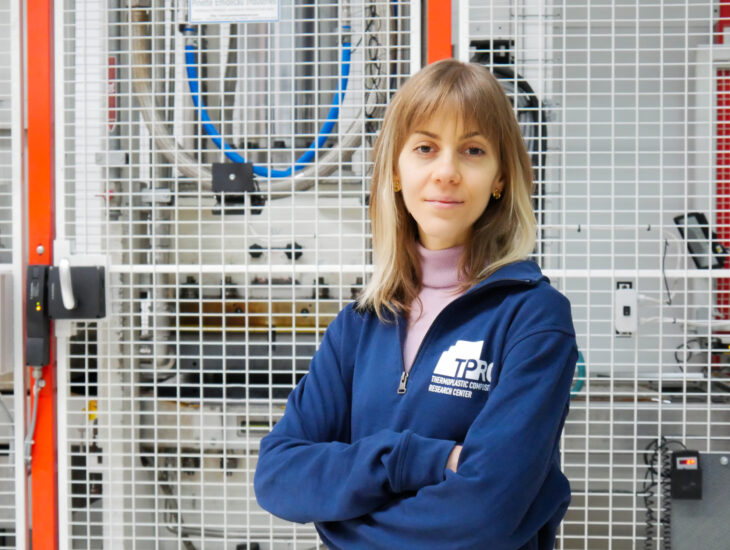
#TPRCminds | Maria
PhD Researcher
What began in southern Brazil as a fascination for materials has led Maria all the way to Twente. At TPRC, where she is now a PhD researcher, she works on conduction welding- a field that allows her to stay close to the lab bench and let her curiosity guide her through practical experimentation.
Read other #TPRCminds interviews with: Rens, who feels right at home in his role as Business Developer (& Senior Research Associate) after receiving his doctorate with honors; Sabrine, who moved from Italy to Twente where she who grew passion for seeing what the naked eye can't see; Edwar & Martin, TPRC's Research Technicians whose work is essential to the research done at TPRC.
Driven by a love for materials
Maria grew up in the very south of Brazil, close to the borders with Uruguay and Argentina. From early on, she was fascinated by materials and the science behind them. “I fell in love with material science in the very first lecture,” she says. Already during her bachelor’s degree in Product Design - a technical programme combining mechanical engineering, industrial design, and material science - she started volunteering in a materials laboratory. The research she conducted at the laboratory served as the basis for her first Master's degree.
Yet the opportunities for research in Brazil were limited. Inspired by her aunt, a medical researcher who had lived abroad for years, Maria knew that to grow as a scientist, she would need to move. A visit to the Netherlands in 2018 left a deep impression. “I always knew I wanted to do research. And if I wanted to be a researcher, I had to go abroad. When I visited the Netherlands, I understood why people spoke so warmly about it.”
In 2022, everything happened quickly: after completing her master’s degree, she prepared for her relocation and began her second master’s at the University of Twente just a few weeks later. She pursued her master's in Industrial Design Engineering and chose the Advanced Materials track.
One conversation that led to TPRC
Maria first heard about TPRC during a material science practical at the UT. One of TPRC’s PhD researchers, Fausto, was working in the lab there, and his work caught Maria’s attention. During their conversation, Maria mentioned her dream to do a PhD. “He told me I should look at TPRC - I had never heard of it before.” Encouraged by that conversation, she reached out to TPRC to ask whether she could help as a student assistant. That step was the beginning of her path into thermoplastic composites.
A passion for material science and experimentation
Thermoplastic composites were still relatively new to Maria when she started her master's in Twente. But her background in materials, combined with her hands-on experience in laboratories, quickly drew her into the field. “I’ve never had a job that was not in research. It’s something I enjoy deeply. I like understanding how things behave, why materials respond the way they do: material science.”
She knew early on that she preferred experimental work over modelling. “I’m not a simulation person,” Maria says. “I like being in the lab. I like touching things, testing things, seeing what happens.” She now focuses on conduction welding. “Conduction welding is a conceptually simple fusion bonding process to create thermoplastic composite joints: heat is applied via metallic tooling and conducted through the laminate to melt the weld zone interface, promoting polymer chain interdiffusion under pressure.”
The field of this technology is still wide open for exploration. “We are building the research direction together. There wasn’t a clear roadmap at the start, and I actually enjoy that. It gives me freedom to discover, adjust, and experiment.”
Research in conduction welding: a field that fits Maria's experimental attitude
Her Brazilian research background, where resources were often limited, is shaping Maria’s approach. “You learn to start with what you have and figure things out along the way. I’m comfortable not knowing every detail upfront, because the research will guide you.” In a field like conduction welding, where information is still developing, Maria’s ability to refine her research focus over time proves essential.
Her project currently focuses on establishing a process–structure–performance framework for conduction welding of thermoplastic composites, with an overall goal of achieving predictable performance of conduction-welded joints through the use of process simulation tools. The predictive models for tool design and process window development are expected to be built upon experimental work, integrating thermal effects related to processing, polymer matrix's crystallization and melting kinetics.
TPRC as a supportive research environment
Maria describes TPRC as a place where responsibility and freedom go hand in hand. “It’s informal in a good way. No one forces you to do anything, but everyone is committed. You feel that people want to build together.”
What stands out to her most is the atmosphere of trust. “When I talk to my supervisors, it always feels like a conversation, not like a report. I never feel judged. That makes you want to do your best.” She appreciates the mix of students, PhDs, and staff, as well as the openness with which everyone shares knowledge. “Everyone is willing to help you”. This nice culture is one of the reasons why Maria hopes to stay in research for the long term.
A future in academia
Maria has a clear dream: becoming a full professor one day. Not necessarily according to a strict timeline, but as a direction she hopes to grow toward. “I like teaching and I like research. I want to stay in academia. And I really like Enschede — it’s the right size, not too chaotic, not too small.”
For now, Maria is fully focused on shaping her PhD research, one experiment at a time. “I don’t plan ten years ahead,” she says. “But I can tell you what I want to achieve for the coming months. And once I get there, I will figure out the next stage.”
Our series #TPRCminds introduces you to the people behind our success. Who are they? What is their background? What drives them and what do they dream about? How do they look at the future of thermoplastic composites? Continue reading other #TPRCminds episodes:

